Before you start
A quick safety check
- Sharp ankle pain when you bend
- Recent ankle surgery or fracture
- Acute swelling or instability
- Barefoot, facing a smooth wall without a baseboard
- You can steady yourself against the wall
- Stop if it hurts - this is a measurement, not a stretch
Setup
How to measure
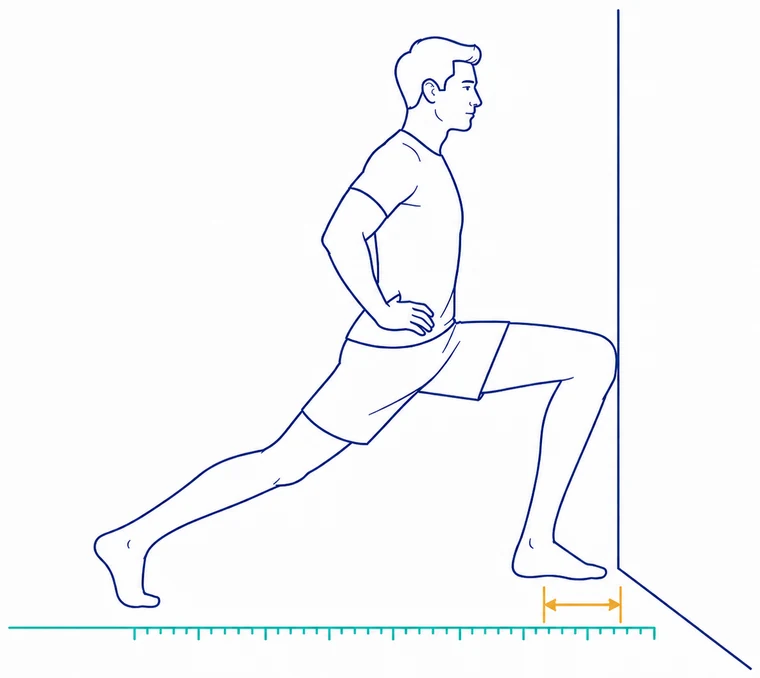
- Put a tape measure on the floor at a right angle to the wall, with 0 at the wall.
- Place your foot on the tape, toe pointing at the wall, other foot behind you.
- Lean your knee forward until it touches the wall - without your heel lifting. Touched easily? Move your foot back and try again.
- The greatest toe-to-wall distance where the knee still touches and the heel stays down is your result.
The measurement
Right leg
Left leg
Measure your right leg and enter the distance
Half-centimeter steps
Your result
Right leg
Left leg
Difference between sides
This test measures weight-bearing ankle dorsiflexion using the Bennell 1998 protocol. Its reliability is high in trained hands (ICC 0.65-0.99).
About the side-to-side difference: a systematic review (Powden 2015) found the smallest change detectable beyond measurement error is about 1.6-1.9 cm. In a small study of 35 healthy adults (Hoch & McKeon 2011) the average difference between sides was close to zero, but larger differences also showed up in people with no injury. So the difference on its own is neither an impairment nor a diagnosis.
There's no comparison to age- and sex-based norms here: an international normative study was published in 2026, and once the full values are available they'll be added to the tool.
A measurement at home is less precise than one in the clinic, and is affected by how the tape is placed, by footwear and by whether you warmed up first.
If you're tracking change over time, repeat the test under the same conditions - same wall, same time of day, barefoot. A change smaller than about 2 cm may come from measurement variability alone.
Want to understand what your result means for you?
This tool is for general guidance only - it isn't a medical diagnosis. Results are anonymous and never stored.
WHERE TO GO NEXT
The Return to Sport questionnaire may be a good fit if your goal is getting back to running or sports.
To the questionnaire →What does the ankle mobility test measure?
It measures ankle dorsiflexion under body weight - how far your ankle bends while you're standing on it. That's the motion that lets your knee travel forward over your foot when you walk, go down stairs, squat or run. The test - known as the Weight-Bearing Lunge Test, or knee-to-wall - was described by Bennell and colleagues in 1998, and it's highly reliable (ICC between 0.65 and 0.99 in a systematic review).
Limited dorsiflexion has been linked to more load on other structures in the leg, and was found to be a risk factor for patellar tendinopathy in junior elite basketball players (Backman & Danielson, 2011).
How to measure properly
Barefoot, facing a smooth wall. Put a tape measure on the floor at a right angle to the wall, with zero at the wall. Put the foot you're testing on the tape with the toe pointing at the wall, and the other foot behind you for balance. You can steady yourself against the wall. Lean the knee forward until it touches the wall without the heel lifting off the floor. If the knee touches easily, move the foot back and try again. The greatest toe-to-wall distance where the knee still touches and the heel stays down is your result. Measure both legs the same way.
What does a difference between sides mean?
Comparing right to left is the interesting part clinically - but read it carefully. A systematic review (Powden et al., 2015) found the smallest change detectable beyond measurement error is about 1.6 to 1.9 cm, so anything smaller than that may just be the measurement itself. In a small study of 35 healthy adults (Hoch & McKeon, 2011) the average difference between sides was close to zero, but larger differences also appeared in people with no injury. So a side-to-side difference, on its own, is neither an impairment nor a diagnosis. It starts to mean something when it shows up again and comes with pain, a past injury or trouble with everyday activities.
Why is there no comparison to age norms here?
Until recently there were no solid reference values for the distance version of this test. An international normative study of 899 healthy participants was published in 2026 with breakdowns by age and sex, and once the full values are available they'll be added to the tool. Until then the tool sticks to what you can actually measure at home: comparing your sides and tracking change over time under the same conditions.