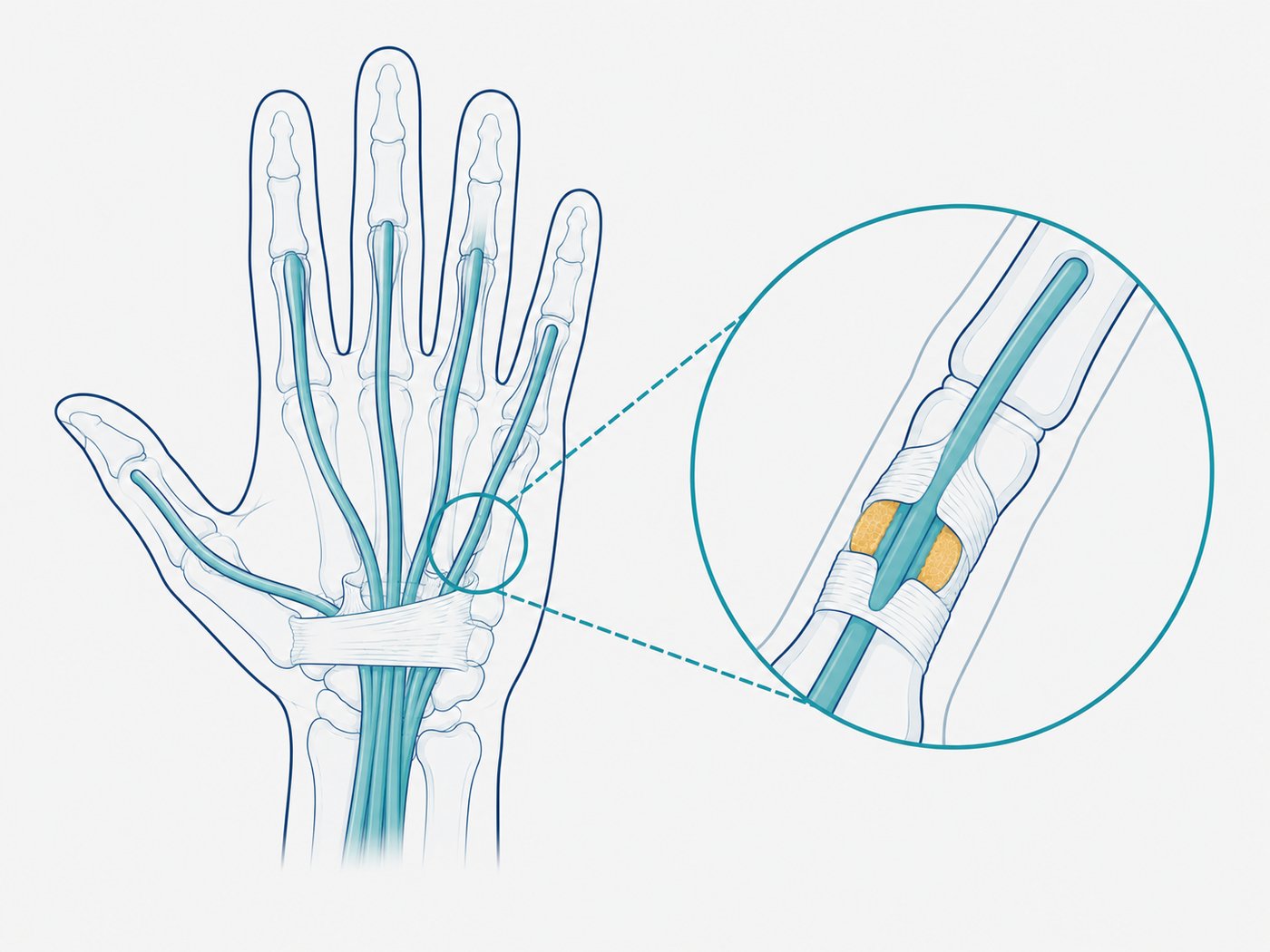
Dupuytren’s contracture: when the fingers gradually pull inward
Gradual thickening and contraction of the tissue of the palm that pulls the fingers into permanent flexion - common in men over 50.
Dupuytren’s contracture is a gradual thickening of the tissue of the palm that pulls the fingers into flexion - a slow and usually painless process, common in men over 50 of northern European descent.
If you have noticed a small, hard lump in the palm, near the base of the fingers, and particularly if over time the little finger or ring finger starts to bend slightly and can’t be fully straightened - this may be Dupuytren’s contracture: a gradual thickening of the tissue beneath the skin of the palm.
This is a slow and usually painless process that develops over months to years - which is why many people ignore the initial lump until it starts to limit movement.
How does it usually feel?
Symptoms can vary, but many describe:
- A small, hard lump in the palm, near the base of the fingers, usually painless.
- Gradually: a hard “cord” that can be felt beneath the skin, along the palm.
- Increasing flexion of one or more fingers, mainly the little and ring fingers.
- Difficulty straightening the affected fingers fully.
- Sometimes it appears in both hands at once.
A simple home test: try placing your palm completely flat on the table. Difficulty doing so because of slight flexion of one or more fingers is a typical sign of Dupuytren’s contracture.
What causes Dupuytren’s contracture?
The precise cause isn’t fully known, but there is a significant hereditary component, and the condition is particularly common in men over 50 of northern European descent. It’s also more common in people with diabetes, and among smokers and people who drink alcohol.
How can physiotherapy help?
In the early stages, when there is still no significant restriction of movement, physiotherapy can help preserve the existing range of motion and monitor the rate of progression. Keep in mind that, unlike other conditions, aggressive stretching doesn’t halt the process itself - it depends mainly on the hereditary and metabolic factor rather than on external mechanical load.
When should you get checked?
If the bending progresses to the point of really interfering with everyday actions - shaking hands, putting on a glove, putting a hand in a pocket - see a hand surgeon about further options, including injections or surgery.
Frequently asked questions
No, this isn’t a malignant disease, but a benign condition that mainly affects the function of the hand over time.
Unfortunately not entirely - the process itself isn’t halted by exercises, but monitoring and preserving movement can help with function along the way.
Only when the restriction is significant and interferes with daily function. In the early stages monitoring is usually sufficient.
What’s worth remembering?
Dupuytren’s contracture is a gradual and usually painless process - early monitoring and identifying the rate at which it progresses help to time the right treatment correctly.
- There is a significant hereditary component; the condition is also more common in people with diabetes, smokers and people who drink alcohol.
- It’s identified by a small, hard lump in the palm near the base of the fingers, and a hard “cord” felt beneath the skin.
- Difficulty placing the palm completely flat on the table is a simple home sign for early identification.
Not sure if this is your situation? I’d be happy to give you a professional assessment and build a treatment plan that fits you.
Book a consultation callYou might also be interested in:
 Pain somewhere else?
Return to the interactive body map and pick an area
←
Pain somewhere else?
Return to the interactive body map and pick an area
←