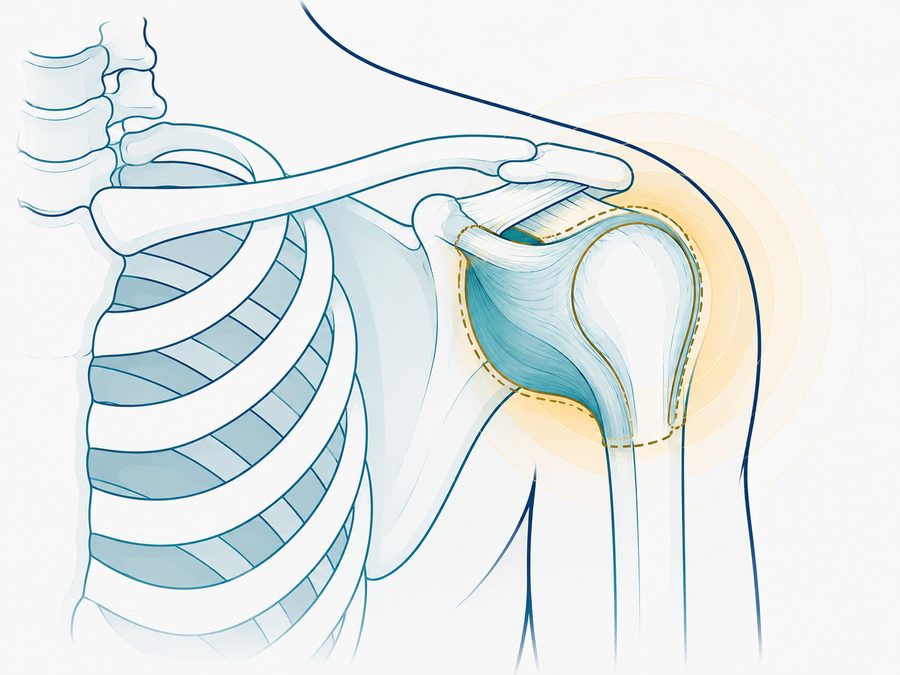
Frozen shoulder: why is it suddenly hard to lift your arm?
Pain and restriction that make it hard to dress, brush your hair or reach a high shelf.
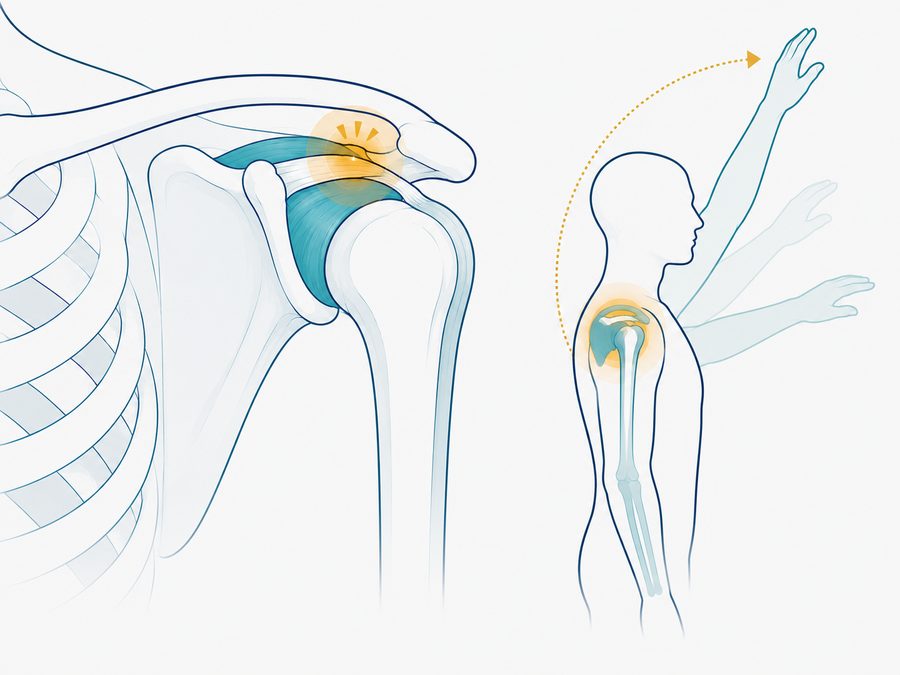
A frozen shoulder develops gradually - usually through a painful phase, a stiff phase, and finally a gradual thaw, though the course differs from person to person. The process can take many months, which is what makes it emotionally frustrating.
Quite a few people say it all started with a small ache in the shoulder. After a few weeks they noticed it was harder to put on a shirt, fasten a bra, brush their hair or reach a high shelf. The movement simply keeps shrinking. This is one of the most emotionally frustrating conditions, because progress is slow and not always linear - there are good days and less good days, and it can feel as though nothing is improving.
This is one of the typical signs of frozen shoulder - a condition that can develop gradually and affect simple everyday activities.
What is frozen shoulder?
In frozen shoulder, the capsule around the joint becomes stiffer, so the range of motion slowly shrinks. It doesn’t happen in a day - usually there’s a worsening stage, a stiff stage, and finally a slow thawing stage. How long each stage lasts varies from person to person.
Don’t lose heart if progress feels slow - frozen shoulder genuinely demands patience, and sometimes the biggest improvement comes right after a period that felt “stuck”.
How does it feel?
- Pain during movement.
- Trouble raising the arm.
- Pain at night.
- Trouble getting dressed or brushing your hair.
- A growing sense of stiffness.
Does it resolve on its own?
Some people improve over time, but it can take many months. The right treatment can reduce pain, preserve movement, and make daily life easier along the way - even if it doesn’t always shorten the process dramatically.
How can physiotherapy help?
After a proper assessment, we build a personal treatment plan. It may include exercises to improve range of motion and reduce stiffness, plus guidance on using the shoulder without overloading it - and above all, support through a process that’s frustrating to go through alone.
How long does a frozen shoulder really last?
The short answer: it is usually a process of many months, and sometimes more than a year - so it helps to know in advance that progress can be slow.
A frozen shoulder is commonly described in three stages - one where pain and stiffness build, one where stiffness dominates, and one of gradual return of movement. In practice, the borders between the stages are not always clear, and the course can differ a lot from person to person.
In the more painful period, pain - especially at night and at the end of the range - can be the main feature. At this stage there is usually no advantage in trying to force the shoulder open, and treatment is matched to how sensitive the shoulder is and to what movement is possible without a meaningful flare-up.
When the pain starts to settle and stiffness becomes the main limitation, it becomes possible to work more on range of motion, strength, and using the arm in daily tasks.
Improvement in a frozen shoulder can take a long time. In some people the progress is substantial within months; in others the process takes a year, two, or even more - a long course is not unusual for this condition in itself. Even after major improvement, some limitation in range can remain that does not necessarily interfere with function.
Physical therapy cannot promise a shorter course, but it can help reduce pain, maintain and improve movement and function, and match the load to the stage the shoulder is in. In the painful periods, other options can also be discussed with your doctor - including a steroid injection, which may help especially in the short term for some people.
The goal is not to "beat" the shoulder by force, but to progress with it gradually - while checking along the way that the diagnosis and the course really do fit a frozen shoulder.
Frequently asked questions
No. Keep moving the shoulder within your limits, with professional guidance - stopping completely tends to make the stiffness worse.
No. Many conditions can cause shoulder pain, so an assessment that tells them apart matters.
Usually many months, and sometimes one to three years, with a pace that varies a lot between people - and not everyone moves through clear stages at the same rate. Even after major improvement, a mild limitation can remain that does not interfere with function.
What’s worth remembering?
Frozen shoulder is frustrating, but in most cases, with the right treatment and persistence, function improves and movement gradually returns.
- The capsule around the joint undergoes a change that makes it stiffer, so the range of motion shrinks gradually over time rather than in a single day.
- Progress isn’t always linear - there are good days and less good days, even when things are heading in the right direction.
- Appropriate treatment doesn’t necessarily “shorten” the process, but it can reduce pain and preserve movement and function throughout.
Not sure if this is your situation? I’d be happy to give you a professional assessment and build a treatment plan that fits you.
Book a consultation callYou might also be interested in:
 Pain somewhere else?
Return to the interactive body map and pick an area
←
Pain somewhere else?
Return to the interactive body map and pick an area
←