Interstitial lung disease: when breathing takes more effort than usual
A group of diseases causing gradual scarring of the lung tissue, with a growing need for tailored respiratory rehabilitation.
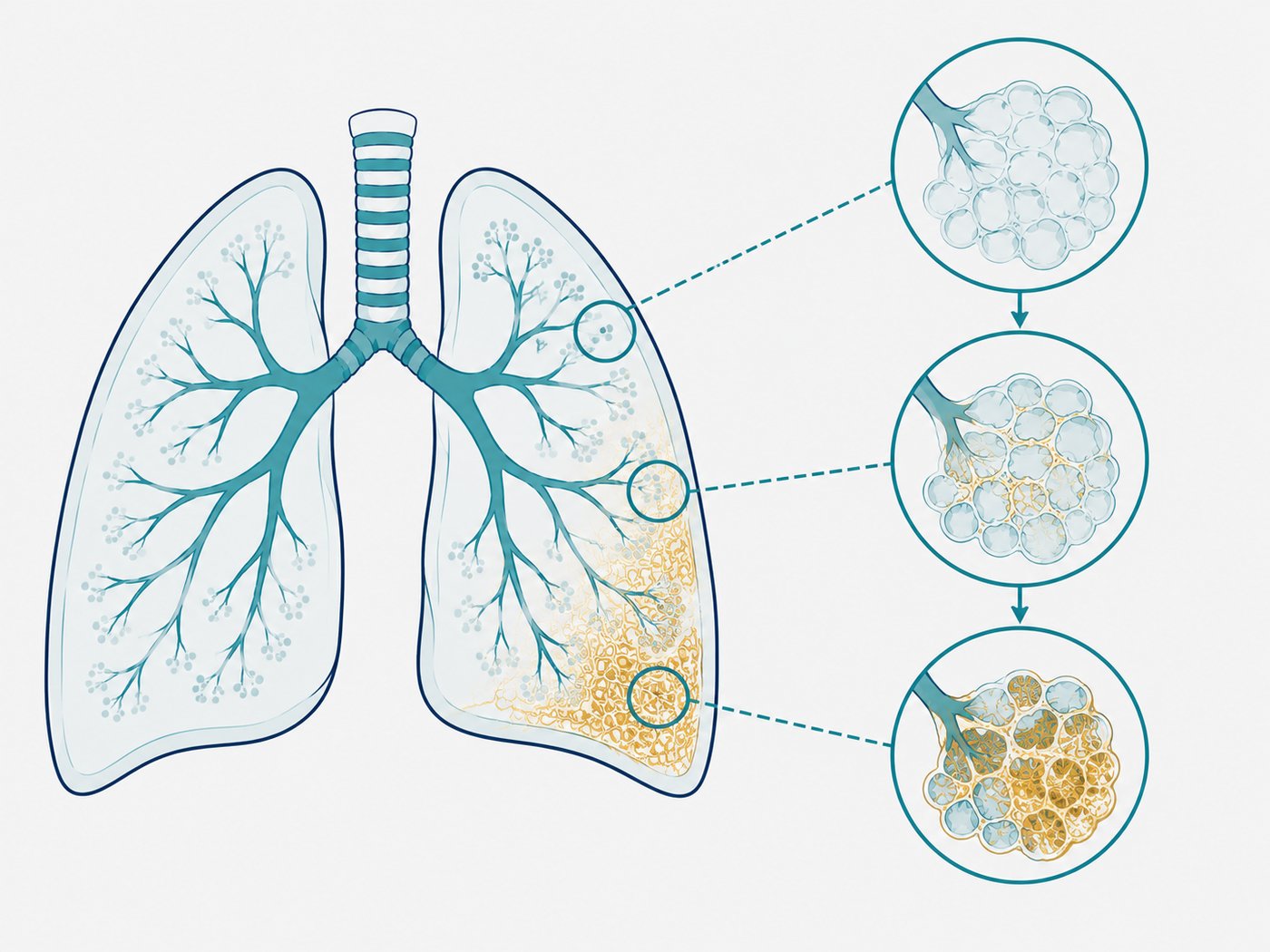
Interstitial lung disease is different from bronchiectasis - here the problem is in the lung tissue itself, which becomes stiffer and struggles to “expand” during breathing, rather than in clearing mucus.
If your shortness of breath on exertion is gradually getting worse over months or years, and comes with a persistent dry cough - this may be interstitial lung disease, a group of conditions that cause gradual scarring (fibrosis) of the lung tissue itself.
Unlike bronchiectasis, where the problem lies mainly in the airways and in clearing mucus, here the problem is in the lung tissue itself, which becomes stiffer and struggles to “expand” during breathing.
How does it usually feel?
Symptoms can vary, but many describe:
- Progressive shortness of breath on exertion, which worsens over time.
- A chronic dry cough, without significant mucus.
- Tiring quickly during activity that used to be easy.
- A gradual reduction in the capacity for daily activity.
- Sometimes a vague sense of “discomfort” in the chest.
Gradually tracking the distance you are able to walk without significant breathlessness is a simple and important tool for monitoring change over time.
What causes interstitial lung disease?
There is a wide range of possible causes - occupational exposure to certain substances, autoimmune diseases, certain medications, and quite often the cause remains unknown (idiopathic pulmonary fibrosis). Accurate diagnosis matters because it affects the choice of medical treatment.
How can respiratory rehabilitation help?
Tailored respiratory rehabilitation focuses on improving the efficiency of breathing, graded physical training that preserves endurance and quality of life as far as possible, and tools for managing the sensation of breathlessness during daily activity. Even when the damage to the lung tissue isn’t reversible, proper rehabilitation can significantly improve function and quality of life.
When should you get checked?
If there is a rapid and marked worsening of breathlessness within a few days, significant chest pain, or nails or lips with a bluish tinge - seek urgent medical assessment immediately.
Frequently asked questions
It depends on the specific cause - there are situations in which medication significantly slows the rate of progression, which is why accurate diagnosis matters.
Quite the opposite - adapted, graded activity is very important for preserving endurance and quality of life, as long as it is matched to your breathing capacity.
No, these are different diseases with a different mechanism of damage to the lung tissue, even though the symptoms can resemble each other.
What’s worth remembering?
Interstitial lung disease is a growing target population with a clear need for respiratory rehabilitation - properly adapting the activity can preserve significant quality of life over time.
- It presents as progressive shortness of breath on exertion and a chronic dry cough without significant mucus, which worsen gradually over months or years.
- The causes include occupational exposure, autoimmune diseases, certain medications, and sometimes a cause that can’t be identified.
- Gradually tracking the distance you can walk without significant breathlessness is a simple and important tool for monitoring change.
Not sure if this is your situation? I’d be happy to give you a professional assessment and build a treatment plan that fits you.
Book a consultation callYou might also be interested in:
 Pain somewhere else?
Return to the interactive body map and pick an area
←
Pain somewhere else?
Return to the interactive body map and pick an area
←