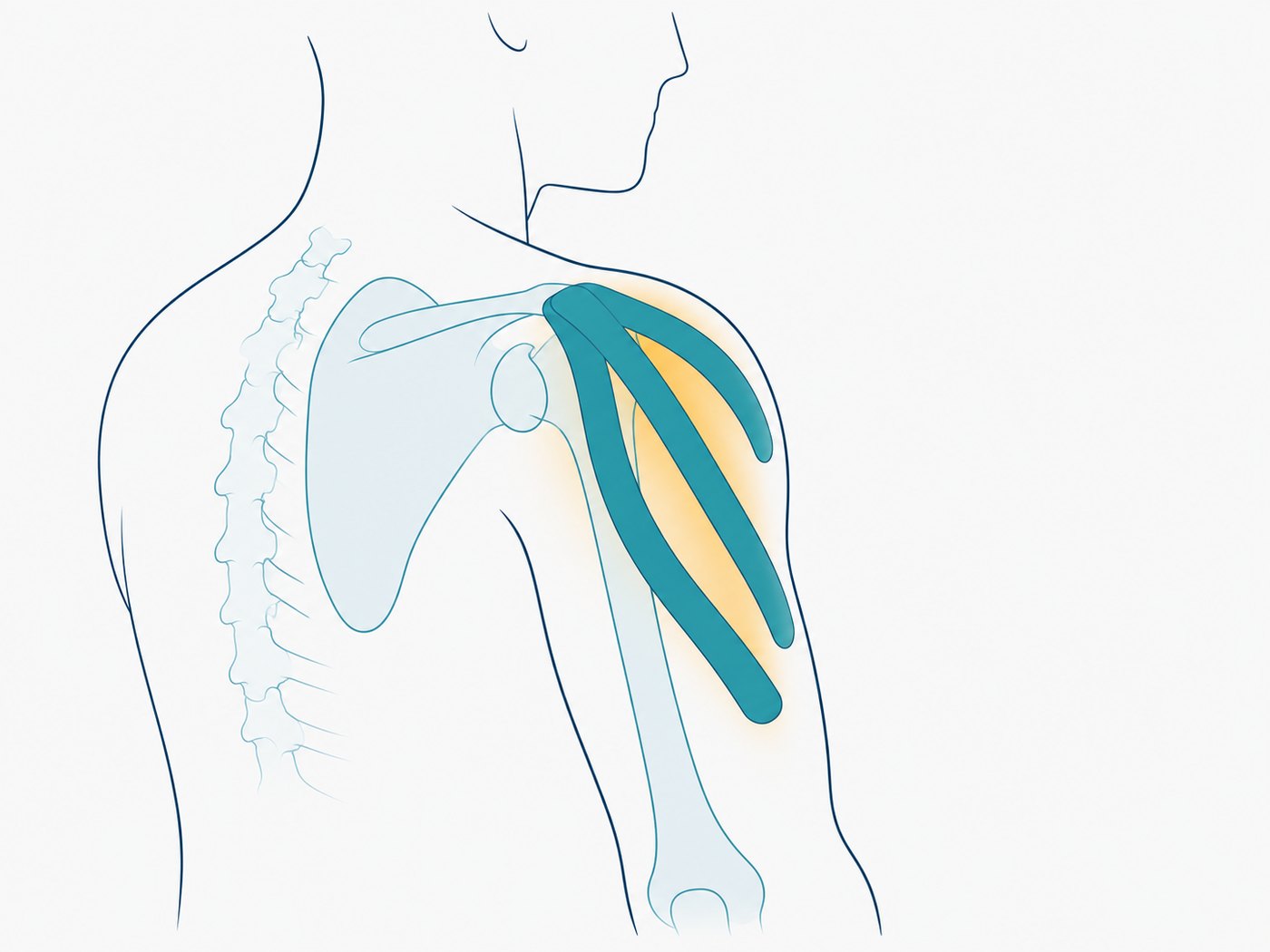
Kinesiology tape: what it really does and when it helps
Colorful elastic taping that supports without limiting movement, with realistic expectations about what it can give.
Kinesiology tape is an elastic tape that adheres to the skin and provides support and sensory feedback without limiting movement. The research points to a modest, mainly short-term contribution, so its place is as a complementary tool to exercise, not a substitute for it.
The colorful elastic strips seen on athletes have become a familiar symbol, and with them come big expectations. It’s worth separating what the tape actually does from what gets attributed to it.
Kinesiology tape is a flexible strip that stretches and adheres to the skin. Unlike rigid strapping, it isn’t meant to immobilize: it allows full range of motion, and works mainly through the skin and sensation.
How is it supposed to work?
Today’s accepted explanation focuses less on mechanics and more on sensation:
- Sensory feedback: The stretch on the skin provides an ongoing stimulus that reminds the body of the area and the movement
- Light support and a sense of security in a sensitive area, without giving up movement
- A possible effect on the sensation of pain through local neural mechanisms
The early explanations, which spoke of "Lifting the skin" and improving lymphatic flow, were studied extensively and did not receive strong support. That doesn’t mean the tape is worthless, but that the mechanism is probably different from what was first assumed.
What does the research say?
This is the part that’s important to say honestly: The research points to a modest contribution.
- Mild pain relief in the short term was reported in several studies
- A better subjective feeling and improved function in certain cases
- versus sham taping The differences were mostly small and not necessarily clinically meaningful
- No evidence that the tape alone treats an injury, shortens recovery, or prevents injuries
So tape presented as a standalone solution is an overblown promise. Tape integrated into a treatment plan, to support a transition period or a return to activity, is a sensible use.
When do I actually use it?
- In a gradual return to sport, When you want support and a sense of security without restriction
- Between treatments, to maintain a good feeling in a sensitive area
- As a movement reminder, When you want to help a patient pay attention to a posture or movement pattern
In all these cases the tape accompanies exercise, and doesn’t replace it.
What’s important to know beforehand?
Application is done on clean, dry skin, and usually stays on for two to four days. You can shower with it.
Remove the tape if you notice Itching, redness, or a burning sensation, which may indicate sensitivity to the adhesive. Do not apply over an open wound, damaged skin, or an infected area.
And finally: the application technique matters less than commonly thought, and the degree of stretch and placement are determined by the goal, not by color or by an example you saw online.
Frequently asked questions
No. All colors are identical in their properties. The difference is purely aesthetic.
You can, but the first application should be a guided one. The placement and degree of stretch derive from the treatment goal, and tape stuck on arbitrarily usually simply does nothing.
Usually two to four days, depending on skin and activity. If skin irritation appears, remove it earlier.
No. These are tools with different purposes. Rigid strapping is meant to limit movement, and the tape is designed precisely not to limit.
What’s worth remembering?
Kinesiology tape is a convenient, safe complementary tool, with a modest, mainly short-term contribution. It helps when it’s part of a treatment plan, and disappoints when it’s expected to be the treatment itself.
- Kinesiology tape supports and provides sensory feedback without limiting range of motion.
- The research points to a modest, mainly short-term contribution, and doesn’t support it as a standalone treatment.
- It fits well into a gradual return to sport and as support between treatments.
Not sure if this is your situation? I’d be happy to give you a professional assessment and build a treatment plan that fits you.
Book a consultation callYou might also be interested in:
 Pain somewhere else?
Return to the interactive body map and pick an area
←
Pain somewhere else?
Return to the interactive body map and pick an area
←