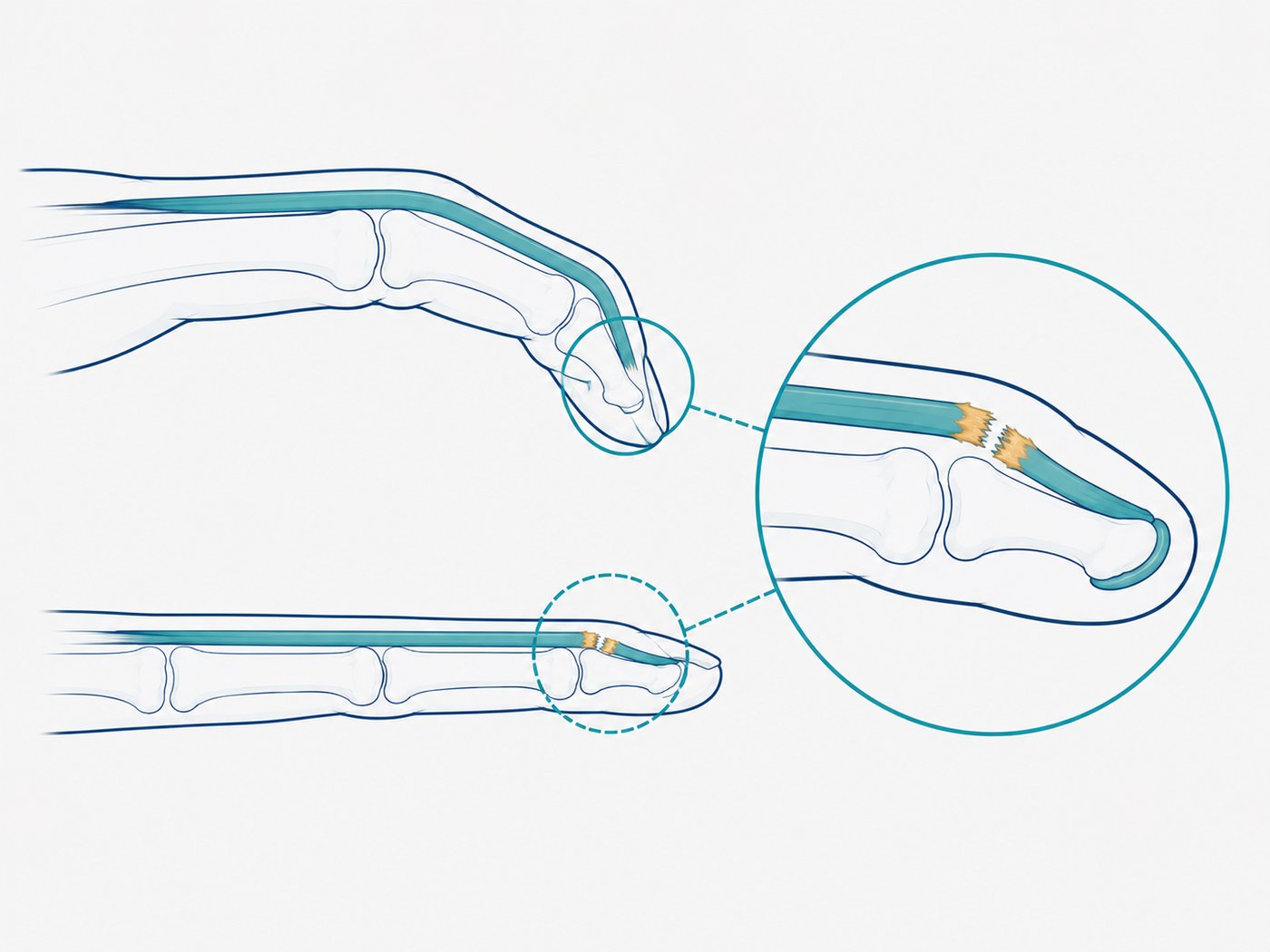
Mallet finger: when the fingertip won’t straighten
An injury to the extensor tendon at the fingertip, very common in ball sports - immediate treatment prevents permanent deformity.
Mallet finger looks like a small, unworrying injury - but immediate and correct treatment is the difference between full recovery and permanent deformity of the finger.
If you took a direct blow to the fingertip, for example from a fast-moving ball in basketball, volleyball or football, and now the fingertip stays bent and you can’t straighten it yourself - this is the classic picture of mallet finger: a tear or injury of the extensor tendon exactly at the end joint of the finger.
This is an injury that looks small and unworrying, but immediate and correct treatment of it is the difference between full recovery and permanent deformity of the finger.
How does it usually feel?
Symptoms can vary, but many describe:
- The fingertip stays bent downward and can’t be actively straightened.
- Pain and mild swelling at the end joint of the finger, immediately after the injury.
- Sometimes slight bruising beneath the nail.
- Pain that worsens when trying to force the fingertip straight.
- Passive straightening (using the other hand) is usually normal.
A simple test: try straightening the fingertip yourself, without help. If you can’t, even if there is no severe pain - that is enough to suspect mallet finger and seek treatment, even if it looks like “just a knock”.
What causes mallet finger?
Most cases are caused by a direct blow from a ball to the fingertip while it is straight, for example an unsuccessful catch. The force pushes the fingertip into a sudden and excessive bend, which tears or damages the extensor tendon at the point where it attaches to the bone.
How is it treated?
The main treatment in most cases is a splint that holds the fingertip in full extension continuously, for around six to eight weeks. During this period physiotherapy focuses on preserving normal movement in the adjacent joints that aren’t immobilised, and after the splint is removed - gradual rehabilitation of strength and movement in the injured joint.
When should you get checked?
If there’s a significant accompanying fracture, joint instability, or the finger isn’t improving at all despite consistent splint use - see a hand surgeon about further treatment.
Frequently asked questions
Yes, continuously and without breaks for the required period - any bending even for a moment, including while changing the splint, can reset the healing process from the beginning.
The deformity becomes permanent - the fingertip will stay bent for good, and sometimes a secondary deformity develops in the joint above it.
In most cases no - a splint does the job. Surgery is reserved for cases with a significant fracture or instability of the joint.
What’s worth remembering?
Mallet finger looks like a small injury, but immediate and consistent treatment with a splint is critical to preventing permanent deformity - don’t underestimate it.
- It’s usually caused by a direct blow from a ball to the fingertip while it is straight, common in basketball, volleyball and football.
- It’s identified by a fingertip that stays bent and can’t be actively straightened, while passive straightening (with the other hand) is usually normal.
- A simple home test - trying to straighten the fingertip yourself - is enough to raise suspicion and seek treatment, even without severe pain.
Not sure if this is your situation? I’d be happy to give you a professional assessment and build a treatment plan that fits you.
Book a consultation callYou might also be interested in:
 Pain somewhere else?
Return to the interactive body map and pick an area
←
Pain somewhere else?
Return to the interactive body map and pick an area
←