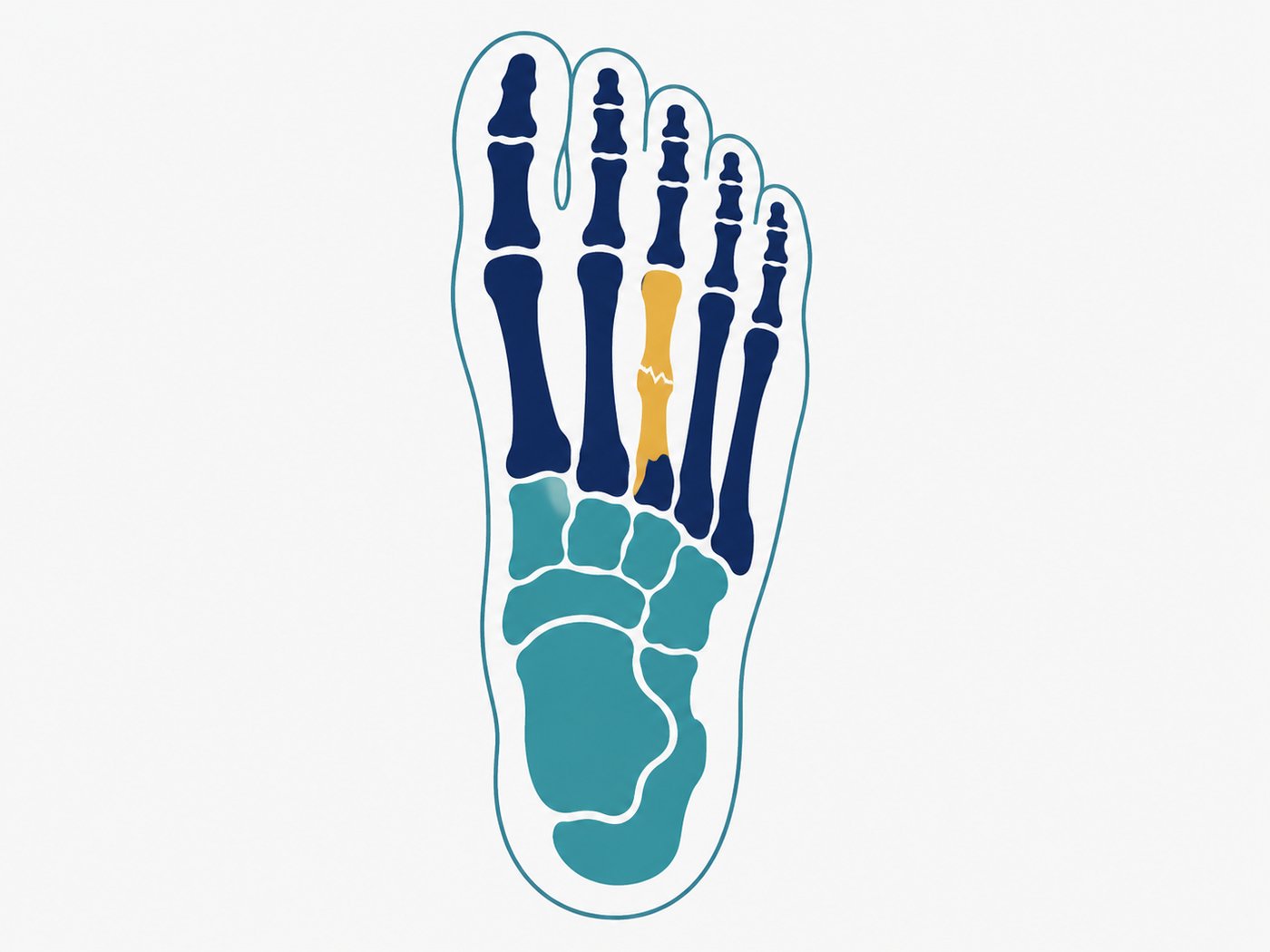
Metatarsal stress fracture: when your foot asks you to stop
A stress fracture in one of the metatarsal bones of the foot - the most common injury of its kind in runners and dancers.
A metatarsal stress fracture is the most common injury of its kind in runners and dancers - and differs from simple inflammation in that it requires genuine rest from load, not just a reduction in it.
If you have progressively worsening pain on the top of the foot, which starts gently and increases with each successive training session, and has not resolved with the usual rest between sessions - this may be a stress fracture in one of the metatarsal bones, the long thin bones on the top of the foot, between the ankle and the toes.
This is the most common type of stress fracture in runners and dancers, and it differs from simple inflammation in that it requires genuine rest from load, not just a reduction in it.
How does it usually feel?
Symptoms can vary, but many describe:
- Progressively worsening pain on the top of the foot, increasing with each successive training session.
- Focal pain at one specific point, which worsens with direct pressure.
- Worsening with walking, running or jumping, with relative relief at rest.
- Sometimes mild local swelling on the top of the foot.
- In advanced stages - pain that appears during ordinary walking or at rest as well.
If the pain starts appearing earlier in each successive training session, rather than simply staying constant - that is an important warning sign pointing to a stress fracture rather than ordinary inflammation, and it requires stopping activity immediately.
What causes a metatarsal stress fracture?
Increasing running volume or intensity too quickly, mainly in runners and dancers, is the most common cause. A change of running surface, unsuitable shoes and low bone density can also increase the risk of a stress fracture in this area.
How is it treated?
Unlike most sports injuries, a stress fracture requires a genuine stop to the mechanical load on the bone for several weeks, not just a reduction in it - this is the most critical stage of recovery. Physiotherapy at this stage focuses on maintaining physical fitness through alternative means that don’t load the foot, and afterwards on a very gradual, staged return to full load.
When should you get checked?
If the pain is severe, comes with real swelling, or you can hardly bear weight - get assessed and consider imaging. Early diagnosis prevents progression to a complete fracture, which takes far longer to heal.
Frequently asked questions
Not always at the early stage - sometimes an MRI or a bone scan is needed for accurate diagnosis in the first phase.
Usually six to eight weeks of significantly reduced load, followed by a gradual return to activity.
Yes, with activities that don’t load the foot, such as swimming or cycling, to maintain fitness while the bone heals.
What’s worth remembering?
A metatarsal stress fracture requires a genuine stop to load, not just a reduction - early identification and respecting the rest period are the key to a safe return to activity.
- Pain that starts earlier in each successive training session, rather than staying constant, is a warning sign pointing to a stress fracture and requires stopping activity immediately.
- It’s identified by focal pain at one point on the top of the foot that worsens with direct pressure.
- Increasing running volume or intensity too quickly is the leading cause, mainly in runners and dancers.
Not sure if this is your situation? I’d be happy to give you a professional assessment and build a treatment plan that fits you.
Book a consultation callYou might also be interested in:
 Pain somewhere else?
Return to the interactive body map and pick an area
←
Pain somewhere else?
Return to the interactive body map and pick an area
←