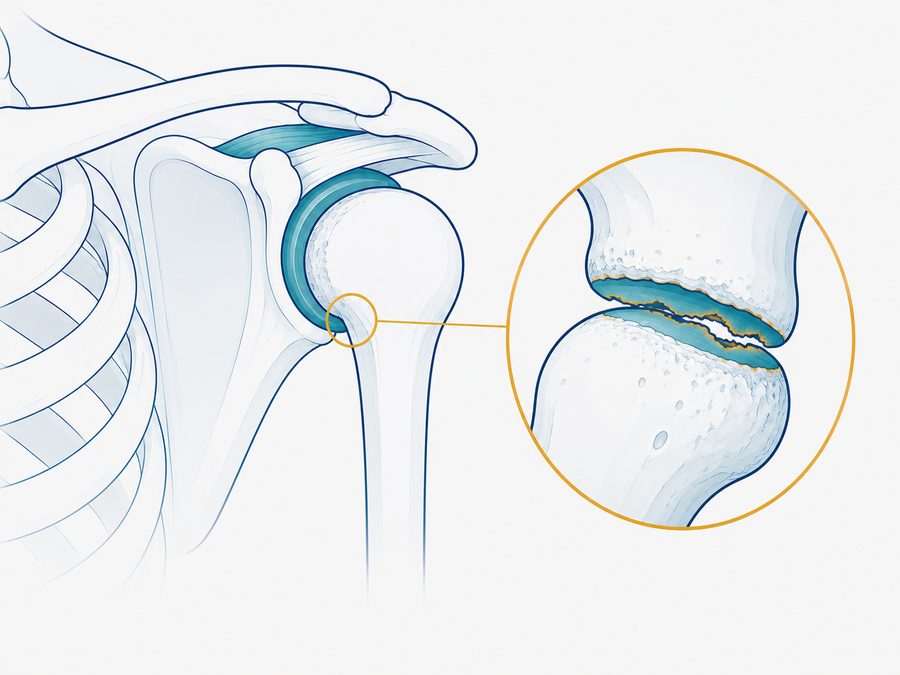
Shoulder osteoarthritis: not every pain means surgery
Pain that appears with movement and is sometimes accompanied by a reduction in the range of motion.
Many patients are frightened by the word “wear” in the shoulder - as though it means the joint is “finished” - but the severity of the findings on an X-ray doesn’t always match the intensity of the pain, and in many cases function can be improved significantly without surgery.
Over the years the shoulder joint undergoes natural changes. In some people these changes come with pain, stiffness and difficulty performing everyday activities such as putting on a shirt or lifting an object onto a high shelf. Even so, in many cases function can be improved significantly without surgery. Many patients come to me frightened by the word “wear” - as though it means the joint is “finished” - and that is exactly the perception I most want to change.
What is shoulder osteoarthritis?
These are changes in the shoulder joint that develop over the years and can cause pain and restricted movement. The severity of the findings on an X-ray doesn’t always match the intensity of the pain - there are people with significant wear on the image who have almost no pain, and the other way around. This is an important point: the X-ray is a tool, not a verdict.
Morning stiffness that improves within a few minutes of movement is very common and not necessarily worrying - the shoulder simply needs to “warm up” after hours without movement during sleep.
How does it usually feel?
- Shoulder pain during movement.
- Stiffness in the morning.
- Difficulty raising the arm.
- A reduction in the range of motion.
- Pain during everyday activities.
How can physiotherapy help?
Treatment includes exercises to improve movement, strengthening the muscles around the shoulder (which support the joint and take load off it), adjusting loads and guidance on how to stay active while reducing the pain.
Frequently asked questions
Not necessarily. Many people manage to maintain good function for years with appropriate treatment - progression isn’t as linear and fixed as people tend to think.
Quite the opposite. Adapted movement is an important part of rehabilitation - a lack of movement actually leads to further stiffness and reduced function.
No. The decision depends on the symptoms, on function and on personal goals - many people live with good function for many years without surgery.
What’s worth remembering?
Even if cartilage wear has been diagnosed, it doesn’t mean you have to give up activity. The right treatment can improve quality of life and ease the pain.
- There are people with significant wear on the X-ray who have almost no pain, and the other way around - the X-ray is a tool, not a verdict.
- Morning stiffness that improves within a few minutes of movement is very common and not necessarily worrying.
- Treatment includes exercises to improve movement and strengthening the muscles around the shoulder that support the joint.
Not sure if this is your situation? I’d be happy to give you a professional assessment and build a treatment plan that fits you.
Book a consultation callYou might also be interested in:
 Pain somewhere else?
Return to the interactive body map and pick an area
←
Pain somewhere else?
Return to the interactive body map and pick an area
←