Meniscus tear - is surgery always necessary?
Meniscus tear - surgery or rehab? What the major trials show, how long recovery takes, when surgery is needed and how to return to sport.
A meniscus tear does not automatically mean surgery: controlled trials - including ten-year follow-up - show that graded rehabilitation matches surgery in most cases, degenerative and traumatic alike. Surgery is reserved for defined situations: a locked knee, a repairable tear in young patients, or failure of quality rehab.
One of the most common diagnoses after knee pain is a meniscus tear. Many people read the words on their MRI report and assume the next step must be an operation. I see it all the time - faces fall the moment they spot that word. In reality the picture is far more nuanced, and the research of the past decade has fundamentally changed how meniscus tears are treated: in most cases, well-structured rehabilitation achieves results equal to surgery - without an operating room.
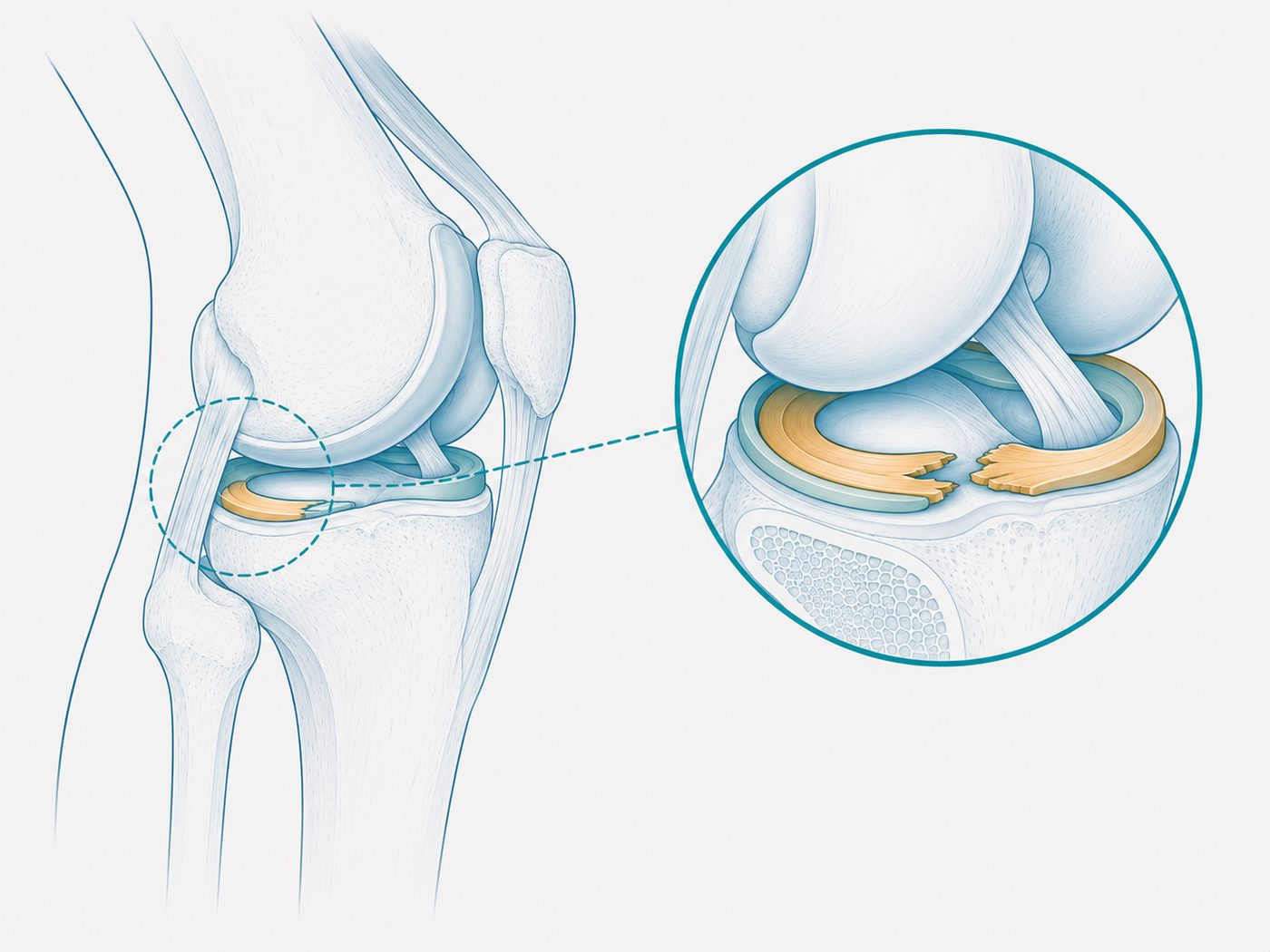
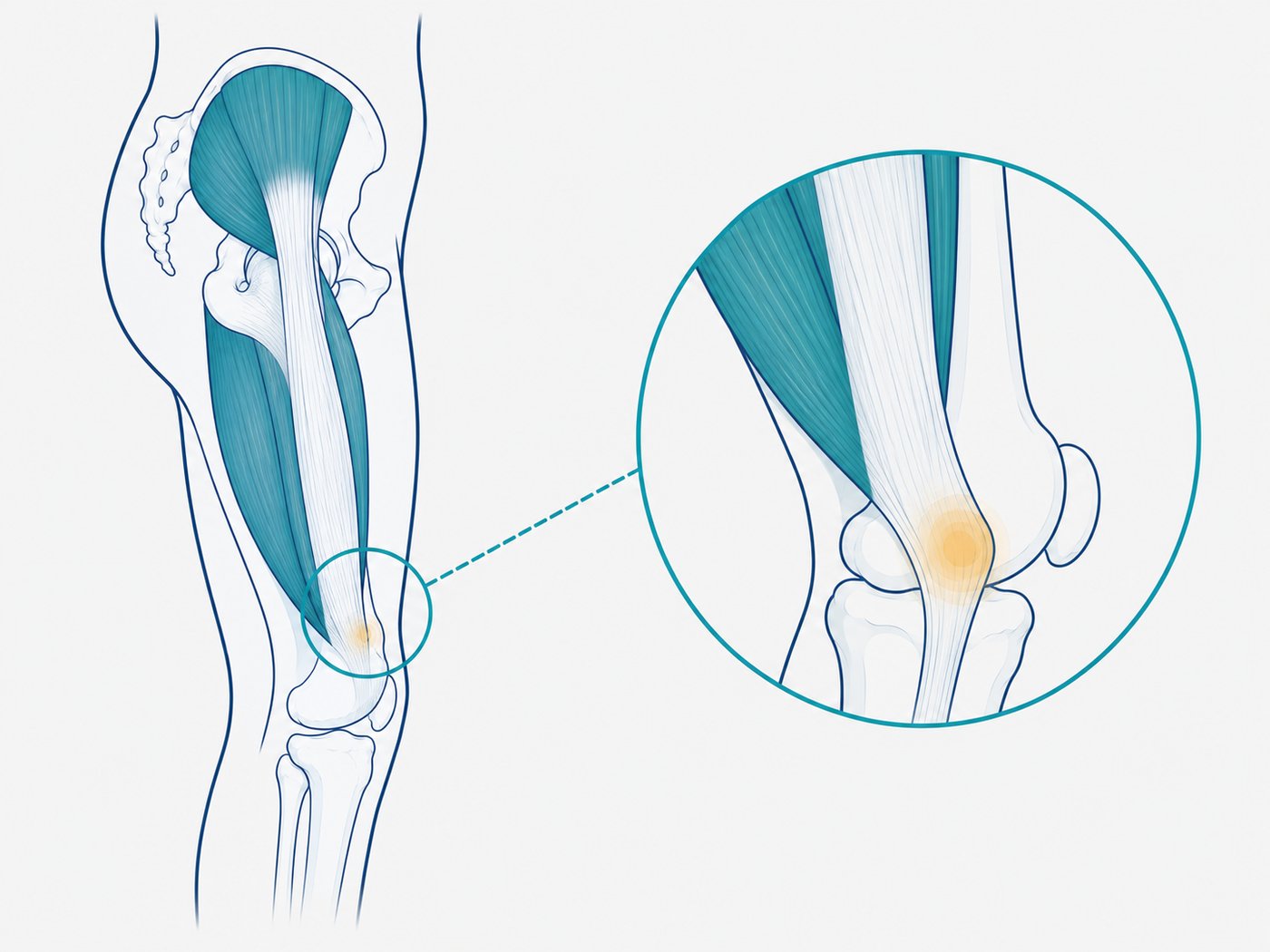
The menisci are two crescent-shaped cartilage structures inside the knee. They absorb shock, distribute load, improve joint stability and protect the articular cartilage. And here is a surprising point: not every tear hurts. Imaging studies have found meniscus tears in a substantial share of people with no knee complaints at all - which is why treatment is never decided by the MRI picture alone, but by symptoms, clinical examination and the impact on your daily function.
Two kinds of tear - and why it changes everything
The single most important distinction, the one that sets the entire treatment path, is between two very different mechanisms:
A traumatic tear - typical of younger people and athletes. It happens in a defined moment: a sharp twist with the foot planted, an awkward landing, a rapid change of direction. It usually brings immediate pain, swelling that develops over the first day or two, and sometimes a click or a locking sensation.
A degenerative tear - typical from around age 40 onward, usually with no clear event. Meniscus tissue loses elasticity over the years, and the tear develops gradually as part of a natural process - sometimes found incidentally, sometimes presenting as pain that appears out of nowhere. A tear like this is largely a sign of natural tissue change, much like wrinkles or graying hair - not a mechanical break that demands repair.
If the knee gets stuck and will not fully straighten, that is an important clinical detail worth mentioning right away - it helps distinguish a tear suited to conservative care from a case needing more urgent evaluation. Another characteristic sign is pain on twisting, for example turning sharply or stepping out of a car.
What do the major studies say?
The meniscus tear is one of the most heavily researched topics in orthopedics, and the accumulated picture is remarkably consistent:
For degenerative tears: a leading Norwegian trial (OMEX) randomized middle-aged patients with degenerative tears to arthroscopic surgery or a three-month exercise program - and followed them for ten years. The result: no difference in pain or function between the groups at any point, and a trend toward slightly more joint degeneration in the surgical group. A large Dutch trial (ESCAPE) reached the same conclusion at five years, and recent meta-analyzes summarize it plainly: exercise matches surgery for pain and function, with a lower risk of progressive knee degeneration.
And perhaps the most striking finding of all: a famous Finnish study compared patients who underwent real arthroscopy with patients who received sham surgery - anesthesia and skin incisions, without touching the meniscus. Both groups improved equally. That finding, published in one of the world’s leading medical journals, changed treatment guidelines worldwide.
What about younger patients? For years the assumption was that young athletes with a confirmed tear must be operated on promptly. A recent Danish trial (DREAM) tested exactly that: patients aged 18-40 with MRI-verified tears were randomized to early surgery or 12 weeks of supervised exercise. Here too - similar outcomes at one year. About a third of the exercise group eventually chose surgery, and the key point is this: they paid no penalty for trying - their final outcome was just as good.
Starting with rehabilitation is almost never missing the boat. Even if surgery is eventually chosen, the exercise period does not compromise the result - and often improves your starting point for the operation and the recovery after it.
What does rehab actually look like?
Conservative care is not waiting for it to pass. A real rehabilitation program - like those tested in the trials - is an active, graded, supervised process built around several goals:
Calming the joint - reducing pain and swelling in the first phase, with smart load management: not complete rest, but movement within the range the knee allows.
Restoring full range of motion - full knee extension is an early, critical goal; without it, everything else stalls.
Targeted strengthening - the quadriceps, hamstrings and hip muscles. These muscles are the shock absorbers that take load off the meniscus itself.
Neuromuscular control - balance, landing stability, sound movement patterns. This is what separates a knee that is strong in the gym from a knee you can trust on the field and in daily life.
Progress is measured by capability, not just the calendar: each phase opens when the knee meets the goals of the previous one.
How long does it take to recover from a meniscus tear?
The short answer: it depends on the type of tear and the treatment path. With conservative care for a degenerative tear, most people feel meaningful improvement within 6-12 weeks. After arthroscopic partial meniscectomy, expect a gradual return to most activities within 4-8 weeks, with sport usually around 7-9 weeks. After a meniscus repair, it is a 3-6 month process, with competitive sport usually around the 6-month mark. Here is each path in detail.
Path A: conservative care
Settling. Reducing swelling and pain, walking safely, gentle early work on extension and flexion.
Building. Range of motion approaching full and gradual strengthening. At this stage you would usually expect to see a trend of improvement in pain, movement, and load tolerance - even if not everything is perfect yet.
Function. Strength, endurance and control in complex movements - stairs, squatting, then light running.
Graded return to sport - straight-line movement first, then changes of direction, and full play last.
Checkpoint: if after 8-12 weeks of consistent rehab there is no trend of improvement, or the knee keeps locking, that is the time for reassessment. And even then, as the trials above showed, surgery is not necessarily the next step.
Path B: after partial meniscectomy
Early walking, usually with immediate weight-bearing as tolerated.
Back to most daily activities.
Gradual return to most activities. Sport is a separate step: systematic reviews show most athletes return to their previous level around 7-9 weeks, and a recent meta-analysis puts the average at about two months. One honest note: among middle-aged recreational athletes, not everyone gets back to exactly their previous level - and that is okay; the goal is a knee that works for the life you actually live.
Path C: after meniscus repair
The key difference: here the tissue needs to heal, so restrictions last longer - sometimes limited weight-bearing or range in the early weeks, depending on the tear type and your surgeon's instructions. That is a price worth paying: a preserved meniscus keeps protecting the cartilage for years to come.
Gradual rebuilding of range, strength, and a normal walking pattern.
Graded return to activity. Competitive sport - usually around 6 months: that is both the most common time criterion in protocols and the average in systematic reviews (5.5-6 months). Per the 2024 EU-US rehabilitation consensus, the return-to-sport decision is made by meeting criteria of strength, symmetry, and function - not by the calendar alone.
What affects the pace of recovery?
Two people with "a meniscus tear" can progress at completely different rates, and that is expected. The main factors: acute versus degenerative tear, tear location (blood supply is better in the outer third), the condition of the surrounding cartilage, consistency with rehab, and the daily load on the knee at work and at home.
True locking of the knee that does not release, swelling that keeps returning and growing, pain that consistently worsens instead of improving, or a persistent feeling of instability - in these situations, do not wait for the window to run out - get assessed.
Timeline based on: the ESSKA-AOSSM-AASPT 2024 consensus · systematic reviews of return to sport after meniscus surgery · the OMEX and ESCAPE trials.
When is surgery the right call?
There are situations where surgery is the right option, sometimes urgently: when the knee is locked and cannot fully straighten or bend because a torn fragment is caught in the joint (typical of a bucket-handle tear); when a young patient has a traumatic tear in a repairable zone - where fixing and preserving the meniscus is preferred; and when significant pain and limitation persist despite a quality rehabilitation program of three months or more. In these cases, an orthopedic surgeon and a physiotherapist weigh the next step together with the patient.
And remember: even when surgery happens, it is not the end of the story but the middle. The rehabilitation that follows largely determines the outcome - restoring range, strength and balance, and preparing an orderly return to activity.
Frequently asked questions
It depends where it is. The outer third of the meniscus has a blood supply and can heal; the inner portions have almost none, so the tear itself usually does not seal over. But that is not the point that matters: pain and function can fully recover even when the tear is still visible on MRI - the goal is a knee that works, not a clean picture.
In most cases yes - and it is encouraged. Controlled movement within a range that does not provoke sharp pain is part of the treatment, not a risk. What is worth postponing during the painful phase: deep loaded squats, sharp pivoting movements and jumping - until the knee is gradually ready for them.
The research shows the opposite of the common fear: in long-term follow-ups, patients treated with exercise did not develop more joint degeneration than those who had surgery - on some measures, slightly less. Trying conservative care first does not damage the knee, and those who opt for surgery later lose nothing by having tried.
No. The clinical diagnosis - your story plus a hands-on examination - is enough to begin safe rehabilitation in most cases. MRI matters when there is suspicion of true locking, an associated injury (such as the ACL), or when surgery is being considered - and then it is an excellent tool.
Light straight-line running - usually around two to three months, once the knee is calm, range is full and strength is reasonably symmetrical. Sports with cutting and contact - usually between three and six months. The decision is made by functional tests, not by a date on the calendar.
For most people with a degenerative tear, conservative care leads to meaningful improvement within 6-12 weeks. The key is the trend: not all pain has to disappear, but you expect gradual improvement in pain, movement, and load tolerance. If after 8-12 weeks of consistent rehab there is no trend of improvement - that is the time for reassessment.
Four signs: true locking of the knee that does not release, swelling that keeps returning and growing, pain that consistently worsens instead of improving, and a persistent feeling of instability. With any of these, do not wait - get professionally assessed.
- The decisive distinction is the type of tear: traumatic (younger, a single event) versus degenerative (40+, gradual) - the treatment path differs accordingly.
- For degenerative tears, structured exercise matches surgery for pain and function even at ten years - with less joint degeneration.
- Even in patients aged 18-40 with a confirmed tear, rehabilitation is a legitimate first line; moving to surgery later does not compromise the outcome.
- Surgery is needed for a locked knee, a bucket-handle tear, a repairable tear in young patients - or failed rehab of three months or more.
- Return to sport: running around two to three months, full sport usually three to six months - by functional tests, not a date.
Not sure if this is your situation? I’d be happy to give you a professional assessment and build a treatment plan that fits you.
Book a consultation callYou might also be interested in:
 Pain somewhere else?
Return to the interactive body map and pick an area
←
Pain somewhere else?
Return to the interactive body map and pick an area
←