Neck pain at the screen? it doesn’t have to be this way
Why our head turns into a 15 kg weight in front of the computer, and what you can do today to take the load off.
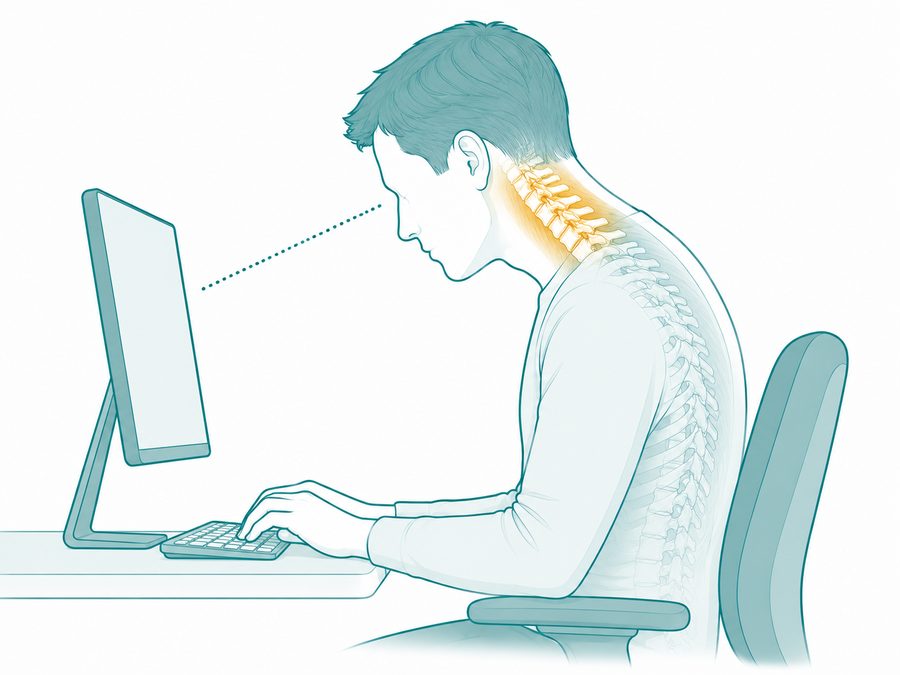
The head weighs about 5 kg on average, but every moment of forward tilt doubles and triples the load on the neck muscles and joints - it isn’t one “wrong” posture, but hours accumulating in a fixed position.
Neck pain has become the most common complaint among people who work at a computer for long hours. Our head weighs about 5 kg on average, and every moment it tilts forward (toward a screen that is too low, or a phone) doubles and triples the load on the neck muscles and the cervical vertebrae. Over time this shows up as stiffness, pain and sometimes headaches and mild dizziness. I see it in the clinic every day - people who arrive feeling that their neck is “locked”, without remembering any specific movement or injury that caused it. Because usually there is no single moment - there is an accumulation of many hours in a poor position.
What actually causes it?
Sitting hunched for long stretches without moving is the most common cause I come across - and the problem is less the “wrong posture” itself and more that it stays fixed for hours without a break. A screen that’s too low or too high makes you tilt your head all day without noticing. The wrong pillow stops the neck from really resting at night, when it’s supposed to recover. Mental stress builds up as tightness in the neck muscles - it isn’t just a saying; stress and muscle tightness in this area really are linked. And long hours without a movement break give the muscles no chance to recover - which is really the main point: not one “perfect” posture, but movement and variety through the day.
What can you do today?
Three small changes that most of my patients notice a difference from within a few days:
- Raise your screen to eye level.
- Take a one-minute movement break every half hour.
- Sleep on a pillow that fills the gap between head and shoulder, without forcing the neck into an unnatural angle.
- Try not to scroll on your phone with your head bent down - raise it to eye level instead.
When should you get professional treatment?
- The pain lasts more than two weeks
- Pain radiating into the arm, or numbness in the fingers
- A real limit on head movement
- The pain comes with frequent headaches
- The pain makes it hard to sleep
- The pain doesn’t improve despite changing position
- The main problem isn’t the posture itself - it’s staying in it for hours without a break to move.
- A poorly positioned screen, an uncomfortable pillow at night and accumulated mental stress held as tightness in the neck muscles all contribute to the problem.
- The real solution is frequent movement, not one “perfect” posture held all day long.
Not sure if this is your situation? I’d be happy to give you a professional assessment and build a treatment plan that fits you.
Book a consultation callYou might also be interested in:
 Pain somewhere else?
Return to the interactive body map and pick an area
←
Pain somewhere else?
Return to the interactive body map and pick an area
←